Digital Products
How to Price Digital Products: A Beginner’s Guide to Setting the Right Price in 2026
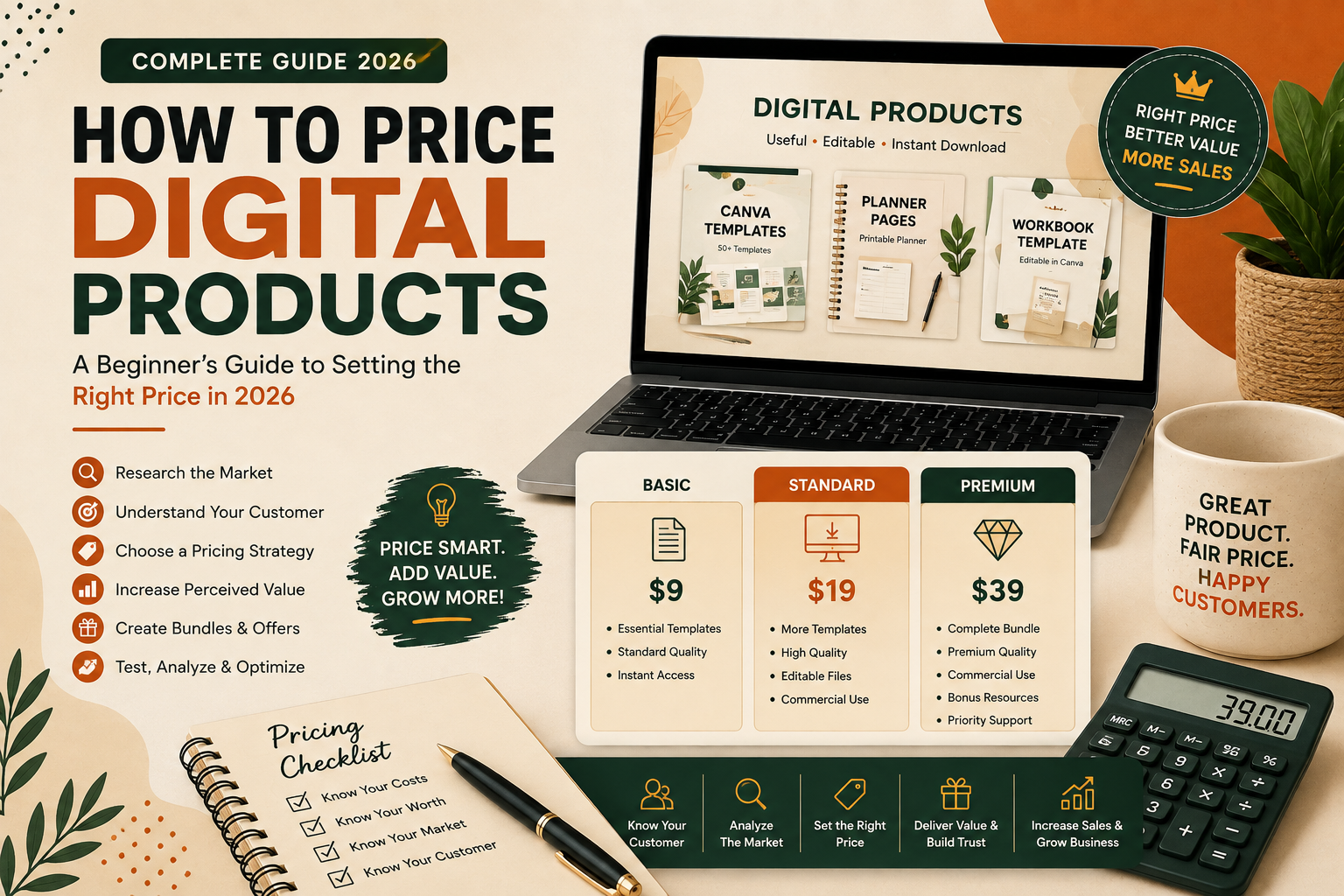
Learn how to price digital products effectively in 2026. Discover the factors that influence pricing, how to research competitors, choose a pricing strategy, create bundles, use discounts and increase the perceived value of your digital products.
One of the most difficult decisions for a new digital product seller is deciding how much to charge. You may create a useful template, printable, planner, ebook or digital bundle, but if the price is too low, you can make your product look less valuable. If the price is too high without enough perceived value, potential customers may simply move on.
Learning how to price digital products is therefore an important part of building a sustainable digital product business.
The good news is that you don't need a complicated formula to get started. You can build a practical pricing strategy by considering your target customer, product quality, competition, time saved, product size, niche and overall value.
In this guide, you'll learn how to research the market, choose a starting price, create bundles, use discounts and improve your pricing strategy over time.
Why Digital Product Pricing Matters
Pricing affects much more than the amount of money you receive from a sale.
Your price can influence how customers perceive the product, how many people are willing to buy it and how much revenue you can generate from the same amount of traffic.
For example, imagine that you sell a digital template for $5.
If you make 20 sales, your gross revenue is $100.
Now imagine that you improve the product, presentation and perceived value and sell it for $15. Even if you make fewer sales, the higher price can potentially generate more revenue.
This doesn't mean that raising your price always increases sales. The goal is to find a price that makes sense for both your customer and your product.
There Is No Universal Price for Digital Products
A common mistake beginners make is looking for one "perfect" price that applies to every digital product.
There isn't one.
A simple printable checklist and a 100-page business workbook should not necessarily have the same price.
Likewise, a single social media template and a complete bundle containing hundreds of editable templates can have completely different price points.
Your price should reflect the overall value and positioning of the product.
1. Understand What You're Actually Selling
Before deciding on a price, identify the outcome your product helps the customer achieve.
Customers aren't necessarily buying a PDF, template or ZIP file simply because they want another digital file.
They may be buying:
- Time savings
- Convenience
- A professional design
- A shortcut
- Organization
- Ideas
- Education
- A ready-made solution
For example, a social media template isn't valuable merely because it contains graphics. Its value may come from helping a business owner create content faster without designing every post from scratch.
Always think about the problem solved, not only the number of files included.
2. Identify Your Target Customer
The same digital product can have different value for different audiences.
A beginner looking for a simple personal planner may have a different budget from a business owner who wants a professional marketing system.
Ask yourself:
- Who is buying this product?
- What problem are they trying to solve?
- How much time does the product save?
- Is the product for personal or commercial use?
- Is the customer a beginner or professional?
- What alternatives are available?
The clearer your target audience is, the easier it becomes to position your product and select a reasonable price.
3. Research Competing Products
Market research is one of the easiest ways to avoid choosing a completely unrealistic price.
Search for products similar to yours and compare several listings instead of looking at only one competitor.
Record information such as:
- Product price
- Number of pages
- Number of templates
- Product format
- Design quality
- Included bonuses
- Customer reviews
- Product presentation
Don't automatically copy the lowest price you find.
Instead, try to understand the market range and determine where your product belongs.
If similar products are generally positioned as premium bundles, selling your own bundle extremely cheaply may make it difficult to build a premium perception.
4. Consider the Time You Save for the Customer
Time can be one of the strongest sources of value for a digital product.
Imagine a customer needs to create 30 social media posts.
They could spend several hours designing everything themselves, or they could purchase a ready-made template bundle and customize the content.
The customer isn't simply paying for the template. They're paying for a shortcut.
This is why a useful, well-organized product can justify a higher price than a collection of random files.
5. Consider Product Quality
Two products can contain a similar number of files while having completely different levels of quality.
Quality can include:
- Professional design
- Easy editing
- Clear instructions
- Consistent formatting
- Useful organization
- Good typography
- High-quality previews
- Helpful bonuses
Before increasing your price, improve the product itself and the customer experience.
A premium price should be supported by a premium experience.
6. Start With a Simple Pricing Range
If you're launching your first digital product, don't spend weeks trying to calculate the perfect price.
Choose a reasonable starting point based on the market, product complexity and target customer.
For example, you might position products approximately like this:
- Simple single resource: low-cost entry product
- Small template bundle: affordable mid-range product
- Large specialized bundle: higher-value product
- Complete resource system: premium product
These aren't fixed market rules. They're simply a way to think about product tiers.
Your actual pricing should depend on your niche, audience, competition and product quality.
7. Create Different Product Tiers
One effective pricing strategy is to create multiple versions of related products.
For example:
Basic
A small collection containing the essential templates.
Standard
A larger collection with additional templates and useful resources.
Premium
A complete bundle containing the main product, bonuses, instructions and additional resources.
This gives customers more than one option and allows people with different budgets to choose the package that fits them best.
8. Use Bundles to Increase Perceived Value
Bundles can be particularly useful for digital products because multiple related resources can be delivered together without increasing physical fulfillment costs.
For example, instead of selling these separately:
- Social media templates
- Content planner
- Instagram story templates
- Content calendar
You could create a:
Complete Social Media Content Bundle
The bundle should have a logical relationship between the included products.
Don't add unrelated files simply to increase the number of items.
9. Don't Compete Only on Price
Beginners sometimes assume that the cheapest product will automatically get the most sales.
That's not always true.
A low price can attract customers, but it can also create problems if your profit per sale becomes too small to support marketing, product development and customer support.
Instead of asking:
"How can I make my product cheaper than everyone else?"
Ask:
"How can I make my product more useful than the alternatives?"
Better instructions, stronger design, clearer organization, niche specialization and useful bonuses can all improve perceived value.
10. Use Introductory Pricing Carefully
When launching a new product, you may decide to use an introductory price.
This can help you collect early customer feedback and test whether your offer converts.
For example, you could launch a product at an introductory price and later move it toward your normal price after improving the product and presentation.
If you use this strategy, clearly communicate the offer instead of creating fake urgency.
Honest promotions are better for long-term customer trust.
11. Test Your Price
Pricing is not necessarily a one-time decision.
You can monitor how customers respond to your product and make informed adjustments.
Track metrics such as:
- Product page visits
- Clicks
- Conversion rate
- Sales
- Refunds
- Customer questions
- Traffic sources
If a product receives traffic but very few people purchase, the problem may not always be the price.
It could be:
- A weak product preview
- An unclear title
- A confusing description
- Poor positioning
- Weak perceived value
- The wrong audience
- A mismatch between the product and the customer's needs
Don't immediately reduce the price without understanding the problem.
12. Improve the Product Before Discounting It
If customers aren't buying, consider improving the offer before reducing the price.
You could add:
- Better instructions
- Additional useful templates
- Bonus pages
- More variations
- Improved preview images
- A better product description
- A clearer delivery process
Sometimes increasing the perceived value can be more effective than simply lowering the price.
13. Use Discounts Strategically
Discounts can be useful when they have a clear purpose.
You might use a discount for:
- A product launch
- A seasonal promotion
- A bundle promotion
- A limited promotional campaign
- A customer appreciation offer
However, avoid keeping everything permanently discounted. If a product is always shown as "50% off," customers may stop believing that the original price represents its actual value.
14. Think About Transaction Costs
Your selling price isn't the same as your final profit.
Depending on the platform you use, you may have costs associated with:
- Payment processing
- Marketplace fees
- Platform fees
- Advertising
- Refunds
- Software subscriptions
Before setting your final price, understand the fees charged by your chosen selling platform.
This is especially important when selling low-priced products because transaction fees can represent a larger percentage of a small sale.
15. Don't Forget Your Time
Your creation time matters too.
If a product takes several days to research, design, test and prepare, selling it for an extremely small amount may make it difficult to build a sustainable business.
This doesn't mean you need to charge customers based directly on your hourly rate.
Instead, consider your overall effort when deciding whether a product is worth creating and how it fits into your product catalog.
16. Build a Product Ladder
A product ladder is a collection of offers that gradually increase in value.
For example:
- Free checklist
- Low-cost printable
- Small template bundle
- Large specialized bundle
- Complete digital resource collection
This structure allows visitors to enter your ecosystem at different levels.
Someone who isn't ready to purchase a premium product might download a free resource first. Later, they may become interested in a paid product after experiencing the quality of your work.
17. Use Freebies as Part of Your Pricing Strategy
Free resources don't have to compete with your paid products.
They can demonstrate your expertise and introduce potential customers to your brand.
For example, if your paid product contains 100 Canva templates, you might offer five useful templates as a free resource.
The free version should provide genuine value while making the difference between the free and paid products clear.
A simple funnel could look like:
Free Resource → Email Subscriber → Helpful Content → Paid Product → Bundle
18. Price Based on the Customer's Use Case
Consider how the customer intends to use your product.
A personal printable and a business resource can have very different commercial value.
For example, a business template that helps a professional create marketing materials may have a different value proposition from a simple personal checklist.
Understanding the use case helps you position the product appropriately.
Common Digital Product Pricing Mistakes
Pricing Too Low
Very low pricing can make it difficult to generate meaningful revenue and may make the product appear less valuable.
Pricing Too High Without Enough Value
A premium price needs a convincing reason. Customers should understand what makes your product worth the additional cost.
Copying a Competitor's Price
Your product may have different quality, features, audience and positioning. Use competitor pricing as research, not as an automatic rule.
Ignoring Platform Fees
Always understand your actual costs before calculating your expected profit.
Discounting Everything
Constant discounts can train customers to wait for sales and can weaken your normal price positioning.
Adding Unnecessary Bonuses
More files don't automatically mean more value. A smaller collection of useful resources can be better than a huge bundle filled with irrelevant material.
A Simple Digital Product Pricing Formula
There isn't a universal mathematical formula that can determine the perfect price, but you can use a simple decision framework.
Consider these five factors:
- Customer: Who is buying?
- Problem: What problem does the product solve?
- Value: How useful is the solution?
- Competition: What are similar products offering?
- Positioning: Is your product basic, standard or premium?
Use the answers to select a starting price that fits your market rather than choosing a random number.
Example: Pricing a Canva Template Bundle
Imagine you've created a collection of 50 Canva social media templates specifically for coaches.
The product includes:
- 50 editable templates
- Multiple post types
- Color customization
- Editable text
- Instructions
- Bonus content planner
Instead of looking only at the number "50," consider the complete offer.
You're providing a niche-specific collection that can potentially save the customer significant design time.
You could then compare similar products, evaluate your design quality and choose an appropriate position within the market.
Later, customer feedback and sales data can help you determine whether the product should remain at that price or be repositioned.
How to Know When to Increase Your Price
You may eventually have reasons to increase the price of a product.
For example:
- The product has been significantly improved.
- You have added valuable bonuses.
- Your product has strong customer demand.
- You have developed a stronger brand.
- Your product is more specialized.
- Your product provides a more complete solution.
If you increase your price, make sure the customer can understand what additional value they're receiving.
Final Thoughts
Learning how to price digital products is an ongoing process. Your first price doesn't have to be perfect.
Start by understanding your customer, researching comparable products and evaluating the actual value of what you're offering.
Then create a price that fits your positioning and monitor the results.
Remember that successful pricing isn't about being the cheapest seller. It's about creating a product that provides enough value for customers to feel that the purchase is worthwhile while also giving your business enough margin to grow.
As your product quality, audience and brand improve, your pricing strategy can improve with them.
Create useful products, communicate their value clearly, test your offers and use real customer data to make better pricing decisions over time.