Digital Products
What Is a Digital Product? Types, Examples & How Digital Products Work
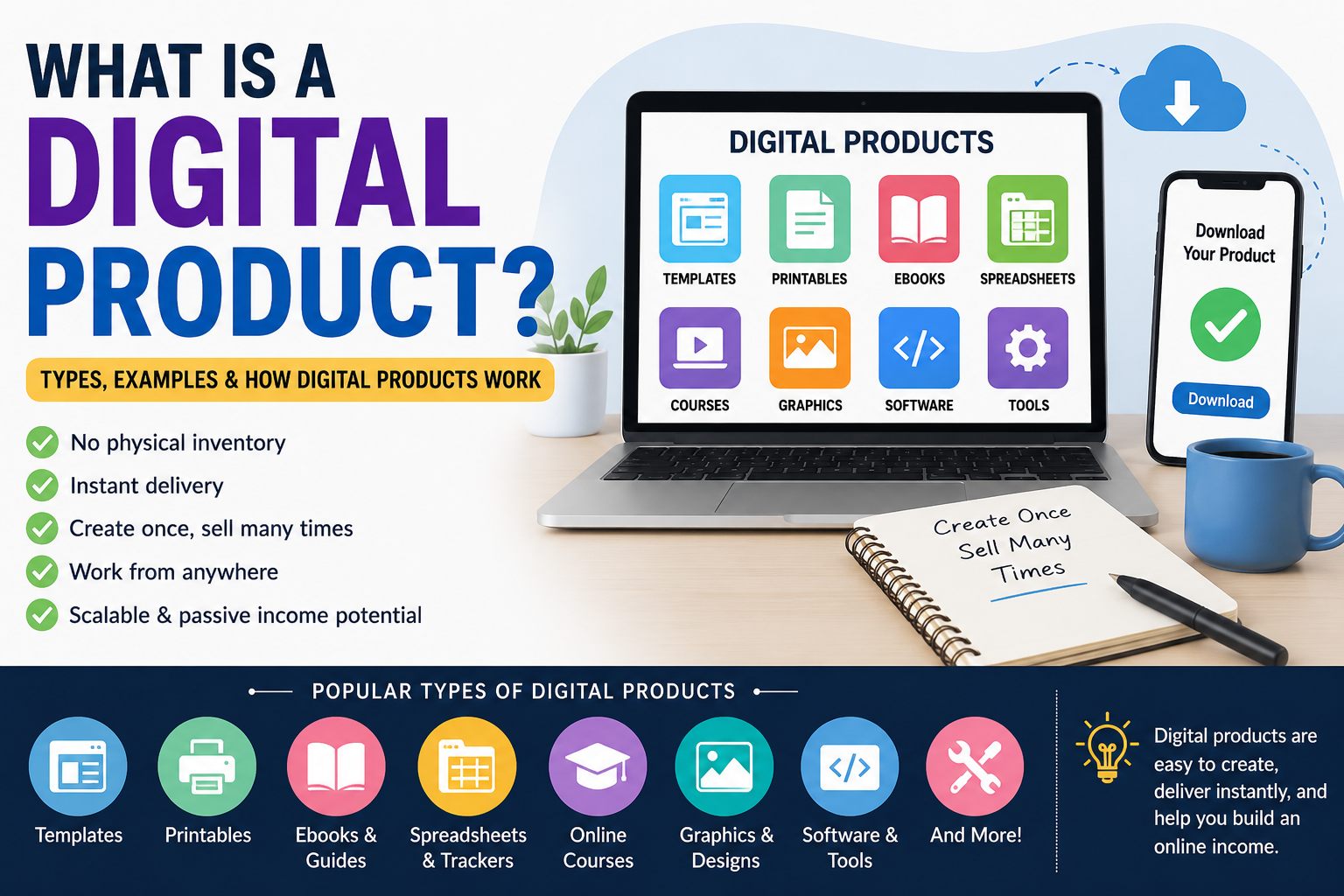
What is a digital product? Learn how digital products work, explore different types and examples, and discover how creators can make, deliver and sell digital products online.
If you've ever downloaded a printable, purchased a Canva template, used an ebook, or downloaded a software tool, you've already interacted with a digital product.
But what exactly is a digital product? How does it work, what types of digital products can you create, and how do creators sell them online?
In this guide, we'll explain what a digital product is, look at practical digital product examples, explore the main types of digital products, and explain how the digital product business model works.
If you're just getting started, you can also visit DigiDown to explore digital resources, tutorials, freebies, and practical tools for digital product creators.
What Is a Digital Product?
A digital product is a product that is created, delivered, and used in digital form rather than as a physical item.
Unlike a physical product, a digital product does not normally require manufacturing, physical inventory, packaging, or shipping. Instead, the customer receives access to a downloadable file, online resource, software application, template, course, or another type of digital content.
Examples of digital products include:
- Canva templates
- Printable planners
- Worksheets
- PDF guides and ebooks
- Spreadsheets
- Digital invitations
- Graphic design resources
- SVG files
- Online courses
- Software and web tools
- Checklists and trackers
- Digital artwork
The important difference is that the customer receives a digital resource instead of a physical object.
How Do Digital Products Work?
The basic process is simple.
- A creator develops a digital product.
- The product is uploaded to an online store or platform.
- A customer discovers and purchases the product.
- The customer receives the digital file or access instructions.
- The customer downloads or accesses the product on their device.
For example, imagine a creator develops a weekly planner as a printable PDF.
The creator uploads the file to a digital marketplace. A customer purchases it and receives the download. The customer can then print the planner at home or use it digitally, depending on the product design.
This is one reason digital products are attractive to creators: the delivery process can often be automated.
Digital Products vs. Physical Products
The biggest difference between digital and physical products is how the product is delivered to the customer.
| Digital Products | Physical Products |
|---|---|
| Delivered digitally | Delivered physically |
| No physical inventory required | Usually requires inventory |
| No traditional shipping | Requires shipping or delivery |
| Can often be delivered automatically | Requires physical fulfillment |
| Can be updated digitally | Physical inventory may need replacement |
Of course, creating a digital product still requires time, skills, research, marketing, customer support, and ongoing improvement.
Types of Digital Products
There are many different types of digital products. Some are simple downloadable files, while others are interactive tools or online experiences.
1. Digital Templates
Templates are pre-designed resources that customers can customize for their own needs.
Popular examples include:
- Canva templates
- Resume templates
- Business templates
- Social media templates
- Presentation templates
- Invoice templates
- Marketing templates
- Invitation templates
The value of a template is that it saves the customer from starting from a blank page.
A well-designed template can provide structure while still allowing the buyer to customize colors, text, images, layouts, and other elements.
If you want to learn how to create this type of product yourself, follow our step-by-step tutorial for creating a Canva template .
2. Printables
Printables are digital files designed to be printed by the customer.
Examples include:
- Planners
- Calendars
- Checklists
- Trackers
- Worksheets
- Activity pages
- Meal planners
- Budget worksheets
Printables can be created for many audiences, including students, teachers, parents, professionals, families, and small business owners.
If you're looking for free examples and useful downloadable resources, explore our free digital resources .
3. Ebooks and PDF Guides
An ebook is a digital book that customers can read on a computer, tablet, phone, or compatible reading device.
PDF guides are another common form of digital product.
They can teach a skill, explain a process, provide instructions, or organize useful information into an easy-to-follow resource.
Examples include:
- Beginner guides
- How-to ebooks
- Workbooks
- Checklists with instructions
- Educational guides
- Business guides
4. Spreadsheets and Trackers
Spreadsheets can become valuable digital products when they solve a specific organization or tracking problem.
Examples include:
- Budget trackers
- Expense trackers
- Inventory spreadsheets
- Content calendars
- Business trackers
- Project planners
- Savings trackers
These products can include formulas, calculations, dashboards, charts, and other useful features.
For example, an interactive budget planner can combine budgeting, tracking, calculations, and reporting features into one digital tool.
You can also browse our digital products to see examples of practical digital resources and tools.
5. Educational Resources
Educational digital products can help teachers, parents, tutors, homeschoolers, and students.
Examples include:
- Alphabet worksheets
- Number worksheets
- Reading activities
- Math practice
- Writing activities
- Learning games
- Classroom resources
- Study guides
The strongest educational resources usually have a clear audience, age group, subject, or learning objective.
6. Digital Graphics and Creative Assets
Graphic resources can be sold as digital downloads for designers, crafters, content creators, and other creative users.
Examples include:
- Clipart
- SVG files
- Digital illustrations
- Patterns
- Icons
- Design elements
- Digital papers
When creating creative assets, originality and file quality are particularly important.
7. Digital Invitations
Digital invitations can be created for birthdays, weddings, baby showers, graduations, bridal showers, business events, and other occasions.
Some invitations are delivered as finished digital files, while others are editable templates that allow customers to change event information themselves.
8. Online Courses and Educational Content
Courses are another type of digital product. Instead of selling a downloadable file, the creator provides educational content through an online platform.
A course might contain:
- Video lessons
- Written lessons
- Workbooks
- Assignments
- Downloadable resources
- Quizzes
Courses usually require more preparation than simple downloadable products, but they can provide a more complete learning experience.
9. Software and Digital Tools
Software is another major category of digital products.
This can include desktop applications, web applications, browser-based tools, calculators, productivity tools, and other software resources.
For example, a creator could build a browser-based budget planner that allows users to enter income, expenses, savings goals, and other financial information.
Unlike a simple PDF, an interactive tool can perform calculations and respond to user input.
Examples of Digital Products for Beginners
If you're new to digital products, you don't necessarily need advanced technical skills to create your first product.
Some beginner-friendly digital product examples include:
- Simple printable planners
- Daily checklists
- Budget worksheets
- Study planners
- Canva social media templates
- Digital invitations
- Simple PDF guides
- Resume templates
- Habit trackers
- Educational worksheets
A simple product that solves a specific problem can be a better starting point than trying to create a huge bundle immediately.
Why Do People Buy Digital Products?
Customers buy digital products because they can provide convenience, structure, information, or a shortcut to completing a task.
For example, someone may purchase a template because they don't want to spend an hour designing a document from scratch.
A student might purchase a study planner because they want a ready-made system for organizing their workload.
A small business owner might purchase a business template because they need a professional-looking document without hiring a designer.
The common factor is value through saved time, reduced effort, useful information, or improved organization .
What Makes a Good Digital Product?
A good digital product should solve a clear problem for a specific audience.
Before creating one, consider these questions:
- Who is the product for?
- What problem does it solve?
- How much time can it save?
- Is it easy to use?
- Does it have a clear purpose?
- Can the customer understand the product before buying?
- Are the included files organized properly?
For example, "Weekly Planner" is a broad product idea. A more specific concept could be "Weekly Study Planner for College Students."
The second idea immediately communicates who the product is for and what problem it is designed to solve.
How Are Digital Products Delivered?
Digital products can be delivered in several ways depending on the type of product.
- Instant file download
- PDF download
- ZIP file containing multiple resources
- Template access link
- Online course access
- Software download
- Browser-based application access
For downloadable products, customers should receive clear instructions explaining what they purchased and how to access or use it.
Where Can You Sell Digital Products?
Creators can sell digital products through marketplaces, digital storefronts, personal websites, and other online platforms.
The best platform depends on the type of product, target audience, pricing model, and marketing strategy.
Marketplaces can provide access to an existing audience, while a personal website can provide greater control over branding and customer experience.
If you're researching what is currently selling in the marketplace, read our guide to best-selling digital products on Etsy in 2027 .
You can also browse DigiDown's digital products for examples of practical templates, tools, and downloadable resources.
Can You Make Money With Digital Products?
Yes, digital products can be sold as a business, but there is no guarantee that a particular product will generate sales.
Success depends on factors such as:
- Product quality
- Customer demand
- Competition
- Pricing
- Search visibility
- Product presentation
- Marketing
- Customer experience
A common misconception is that creating a digital file automatically creates passive income. In reality, successful digital product businesses usually require research, product development, listing optimization, marketing, customer support, and continuous improvement.
How to Start With Your First Digital Product
If you're a beginner, keep your first product simple.
- Choose a specific audience.
- Identify a problem they have.
- Research what people are searching for.
- Create a simple solution.
- Make the product easy to use.
- Create clear preview images.
- Write an accurate product description.
- Choose a suitable selling platform.
- Publish the product.
- Collect feedback and improve it.
Once you have one useful product, you can create related products for the same audience instead of constantly starting from zero.
For more practical help with creating digital products, explore our digital product tutorials .
Digital Products Are More Than Just Downloads
When people hear "digital product," they often think only about PDFs and printable files.
But the category is much broader.
A digital product can be a template, educational resource, ebook, spreadsheet, creative asset, online course, software tool, or interactive web application.
The common characteristic is that the product is delivered and consumed digitally.
Final Thoughts
A digital product is essentially a product that exists in digital form and can be delivered electronically to a customer.
From simple printables and templates to courses, ebooks, spreadsheets, creative assets, and software tools, there are many different types of digital products you can create.
The best starting point isn't necessarily the most complicated product. Instead, focus on finding a specific audience, identifying a real problem, and creating a useful solution.
If you're interested in learning more, explore our tutorials , discover our free digital resources , browse our digital products , or read our Etsy digital product guide .
You can also return to the DigiDown home page to explore the full range of resources available.
Once you understand what digital products are and how they work, the next step is turning a useful idea into a product that people actually want.