Etsy & Digital Product Research
How to Find Best-Selling Digital Products on Etsy: Trends & Research Tools
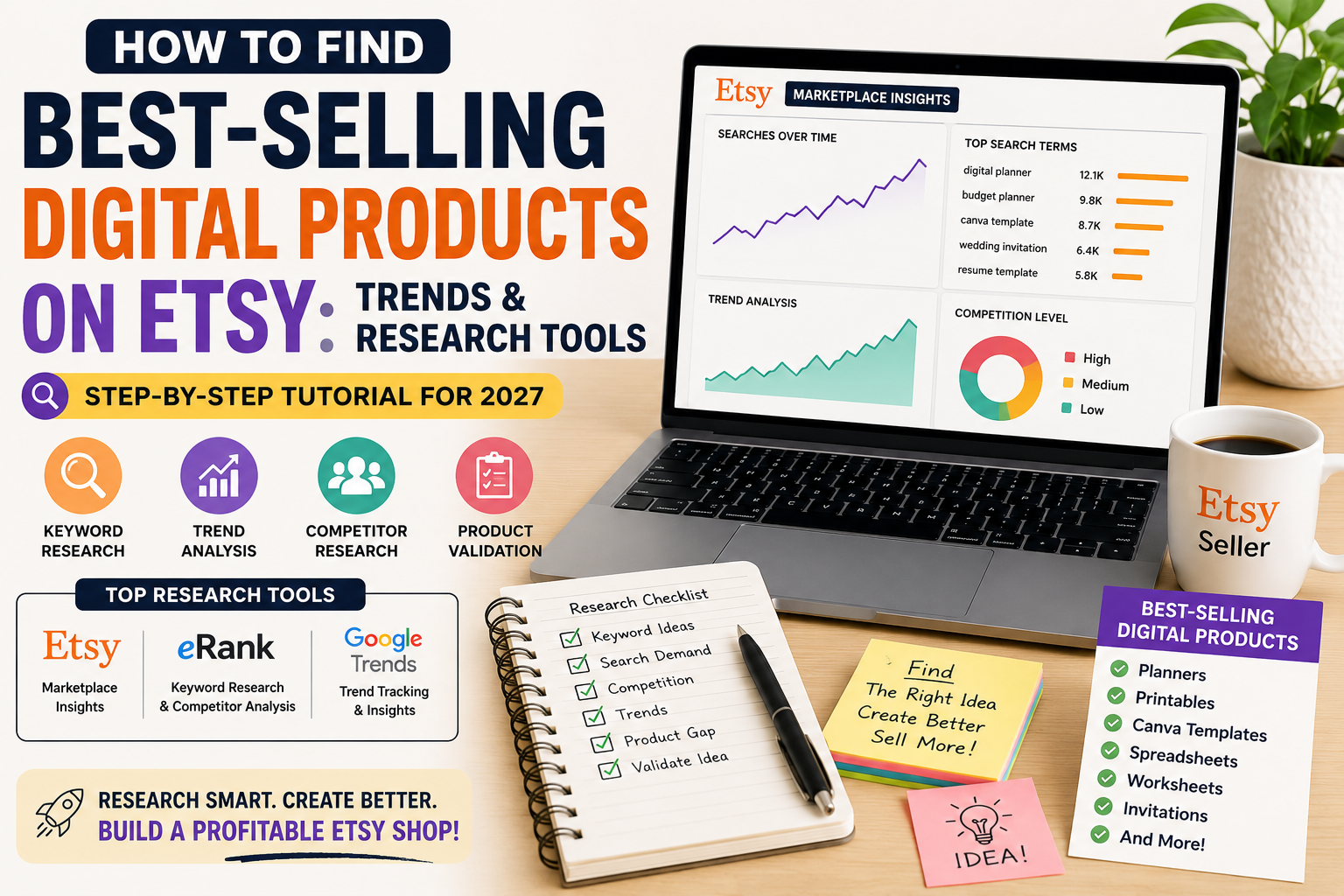
Learn how to research best-selling digital product ideas on Etsy using keyword research, competition analysis, trend data, competitor research, and tools like Etsy Marketplace Insights and eRank.
Finding a digital product idea is easy. Finding a digital product that people actually want to buy is much harder.
If you want to sell digital products on Etsy in 2027, you should not choose products based only on guesswork. A better approach is to combine keyword research, search demand, competition analysis, trend research, and competitor research.
In this tutorial, you'll learn exactly how to research best-selling digital products on Etsy, discover long-tail opportunities, analyze competing listings, and use research tools to decide which product ideas deserve your time.
If you're completely new to digital products, first read our guide: What Is a Digital Product? Types, Examples & How Digital Products Work .
What You'll Learn in This Tutorial
- How to find digital product ideas on Etsy
- How to use Etsy Marketplace Insights
- How to use eRank for keyword research
- How to find long-tail Etsy keywords
- How to compare search demand and competition
- How to research competitor listings
- How to identify product gaps
- How to research seasonal trends
- How to score digital product ideas
- How to decide which product to create first
Step 1: Choose a Broad Product Category
Start your research with a broad category instead of immediately choosing one specific product.
For example, you could start with:
- Planners
- Printables
- Canva templates
- Resume templates
- Business templates
- Wedding templates
- Teacher resources
- Budget templates
- Social media templates
- Digital invitations
The purpose of this first step is to create a starting point for keyword research. You will narrow the idea down later.
Step 2: Find Related Product Ideas
Once you have a broad category, start looking for related products.
For example, if your broad keyword is budget planner, related product ideas could include:
- Monthly budget planner
- Printable budget planner
- Budget spreadsheet
- Debt payoff tracker
- Savings tracker
- Expense tracker
- Cash stuffing tracker
- Family budget planner
- Student budget planner
At this stage, don't worry about creating anything. Your goal is to build a list of possible opportunities.
Step 3: Use Etsy Marketplace Insights
Etsy provides its own research tool called Marketplace Insights.
Marketplace Insights gives sellers access to Etsy search data and can show search activity, related search terms, listing competition, and trend information.
According to Etsy's current documentation, you can access Marketplace Insights from:
Shop Manager → Stats → Marketplace Insights
You can read Etsy's official guide here: Etsy Marketplace Insights .
The tool can help you discover what buyers are searching for and identify related terms that may have attractive demand relative to competition.
Step 4: Search Your Main Keyword
Enter your broad product keyword into Marketplace Insights.
For example:
- digital planner
- budget planner
- Canva template
- resume template
- wedding invitation
Don't immediately choose the first keyword you see. Instead, collect several related keywords and compare them.
Step 5: Look for Long-Tail Keywords
One of the most important parts of Etsy product research is finding long-tail keywords.
A broad keyword might be:
planner
A more specific long-tail keyword might be:
weekly digital planner for students
Long-tail phrases can tell you much more about the shopper's actual intention.
| Broad Keyword | Long-Tail Keyword |
|---|---|
| planner | weekly planner for students |
| budget planner | monthly budget planner printable |
| resume template | minimalist resume template Canva |
| business template | small business invoice template |
| teacher worksheet | kindergarten alphabet tracing worksheet |
eRank also recommends moving from broad keywords toward more specific long-tail phrases because these can reveal clearer shopper intent.
You can explore eRank's Keyword Research Tool to investigate keyword demand, competition, clicks, trends, and related search opportunities.
Step 6: Compare Search Demand and Competition
High search volume alone does not automatically mean that a keyword is a good opportunity.
You should compare demand with competition.
| Keyword | Search Demand | Competition | Difficulty |
|---|---|---|---|
| digital planner | High | Very High | Hard |
| student digital planner | Medium | Medium | Moderate |
| digital planner for nursing students | Lower | Lower | Potential niche |
The smaller keyword may have fewer searches, but it can also target a much more specific audience.
Your goal is not necessarily to find the keyword with the largest volume. Your goal is to find a keyword where demand, relevance and competition make sense for your product.
Step 7: Research the First Page of Etsy
After finding promising keywords, search them directly on Etsy.
Study the listings appearing on the first page.
Look at:
- Product type
- Product price
- Thumbnail design
- Number of listing images
- Product title
- Product description
- Reviews
- Customization options
- File formats
- Bundles and bonuses
You are not trying to copy successful sellers. You are trying to understand what customers are already being offered and where you might provide something better or more specific.
Step 8: Look for a Product Gap
A product gap is an opportunity where existing products do not completely satisfy a particular customer need.
For example, you might discover:
- Popular products with outdated designs
- A niche with very few specialized products
- Templates that are difficult for beginners to edit
- Products that lack clear instructions
- Products that are not mobile-friendly
- Broad products that could be customized for a specific audience
Instead of creating another generic product, you can use this information to create a more targeted solution.
Step 9: Research Product Trends
Trends are another important part of product research.
A product category may be popular today but decline later, while another category may just be beginning to grow.
Look for keywords that are:
- Growing
- Stable
- Seasonal
- Emerging
- Declining
Etsy's Marketplace Insights includes trend information, while eRank also provides trend and historical keyword research tools.
Step 10: Research Seasonal Products
Some digital products experience strong demand during particular seasons or events.
Examples include:
- Halloween printables
- Christmas templates
- Wedding planners
- Graduation invitations
- Teacher resources
- Valentine's Day printables
- Birthday invitations
- Holiday planners
The key is to research seasonal demand before the peak arrives instead of waiting until the market is already crowded.
Step 11: Use eRank for Deeper Research
eRank can be useful when you want to go deeper than a basic Etsy search.
Its research tools provide keyword information, competition insights, trend data, and competitor research features.
Start with a broad keyword and then investigate the related keyword ideas. Look for relevant multi-word phrases that have a reasonable balance between demand and competition.
eRank's own keyword research guidance also recommends moving from broad keywords toward more specific long-tail phrases when researching Etsy listings.
Explore eRank Keyword Research
Step 12: Create a Product Research Spreadsheet
Don't keep your research only in your browser. Create a simple spreadsheet so you can compare product ideas.
Useful columns include:
- Product idea
- Main keyword
- Related keywords
- Search volume
- Competition
- Trend direction
- Average price
- Competitor listings
- Reviews
- Target customer
- Product difficulty
- Opportunity score
Step 13: Score Your Product Ideas
You can create a simple scoring system to rank your ideas before spending time creating them.
| Factor | Score |
|---|---|
| Search demand | 1–10 |
| Competition opportunity | 1–10 |
| Buyer intent | 1–10 |
| Trend potential | 1–10 |
| Ease of creation | 1–10 |
| Profit potential | 1–10 |
Add the scores together and compare your shortlisted products.
This does not guarantee sales, but it gives you a consistent way to compare ideas instead of choosing products based purely on intuition.
Step 14: Validate the Product Before Creating It
Before spending several hours designing a product, go back through your research and ask:
- Are people searching for this type of product?
- Is there a clear target customer?
- Is the competition manageable?
- Is there a specific long-tail keyword?
- Can I make the product better or more useful?
- Can I create a professional listing?
- Can I price it competitively?
If most answers are positive, the product deserves further consideration.
Common Etsy Product Research Mistakes
1. Choosing Only High-Volume Keywords
High search volume can also mean high competition. Always examine the competition and relevance of the keyword.
2. Copying the Top Seller
A successful listing is evidence of demand, not permission to copy its design, branding, images, descriptions, or product.
3. Ignoring Long-Tail Keywords
Broad keywords are useful for discovering a niche, but specific phrases can reveal much clearer buyer intent.
4. Creating Before Researching
Research the opportunity first. Then invest your design time into the strongest ideas.
5. Following Every Trend
A trend is only useful when it matches your audience, product capabilities, and business strategy.
A Simple Etsy Product Research Workflow
- Choose a broad product category.
- Enter the keyword into Etsy Marketplace Insights.
- Collect related keywords.
- Find long-tail keyword opportunities.
- Compare demand and competition.
- Search the strongest keywords on Etsy.
- Study competing listings.
- Look for product gaps.
- Check trends and seasonality.
- Record everything in a spreadsheet.
- Score your product ideas.
- Choose the strongest opportunity.
- Create and publish the product.
- Monitor its performance and improve it.
What Should You Do After Finding a Product Idea?
Once your research identifies a promising product, the next step is creating the actual digital product.
For example, if your research shows that Canva templates are a promising niche, you can learn how to create one with our How to Create a Canva Template: Step-by-Step Tutorial .
You can also explore our tutorials section for more practical guides related to digital products.
Explore More Digital Product Ideas
Product research becomes much easier when you understand the different types of digital products you can create.
Our article 10 Best Digital Products to Sell can help you explore different product categories and identify ideas that may fit your skills and target audience.
You can also explore our free digital resources for practical examples and downloadable resources.
Final Thoughts
Finding best-selling digital products on Etsy is not about discovering a secret list of guaranteed winners.
A better strategy is to understand what shoppers search for, how much competition exists, which trends are growing, and what successful sellers are already offering .
Start with Etsy Marketplace Insights, expand your research with eRank, investigate long-tail keywords, study competitor listings, and look for product gaps that you can serve with a better or more specific solution.
Most importantly, don't create a product simply because another seller is making sales. Use the research to understand the customer and then create something genuinely useful for that audience.
If you want to continue exploring DigiDown, visit the DigiDown home page or browse our digital products .