Blog
Free vs Paid Templates: What Actually Converts to Sales?
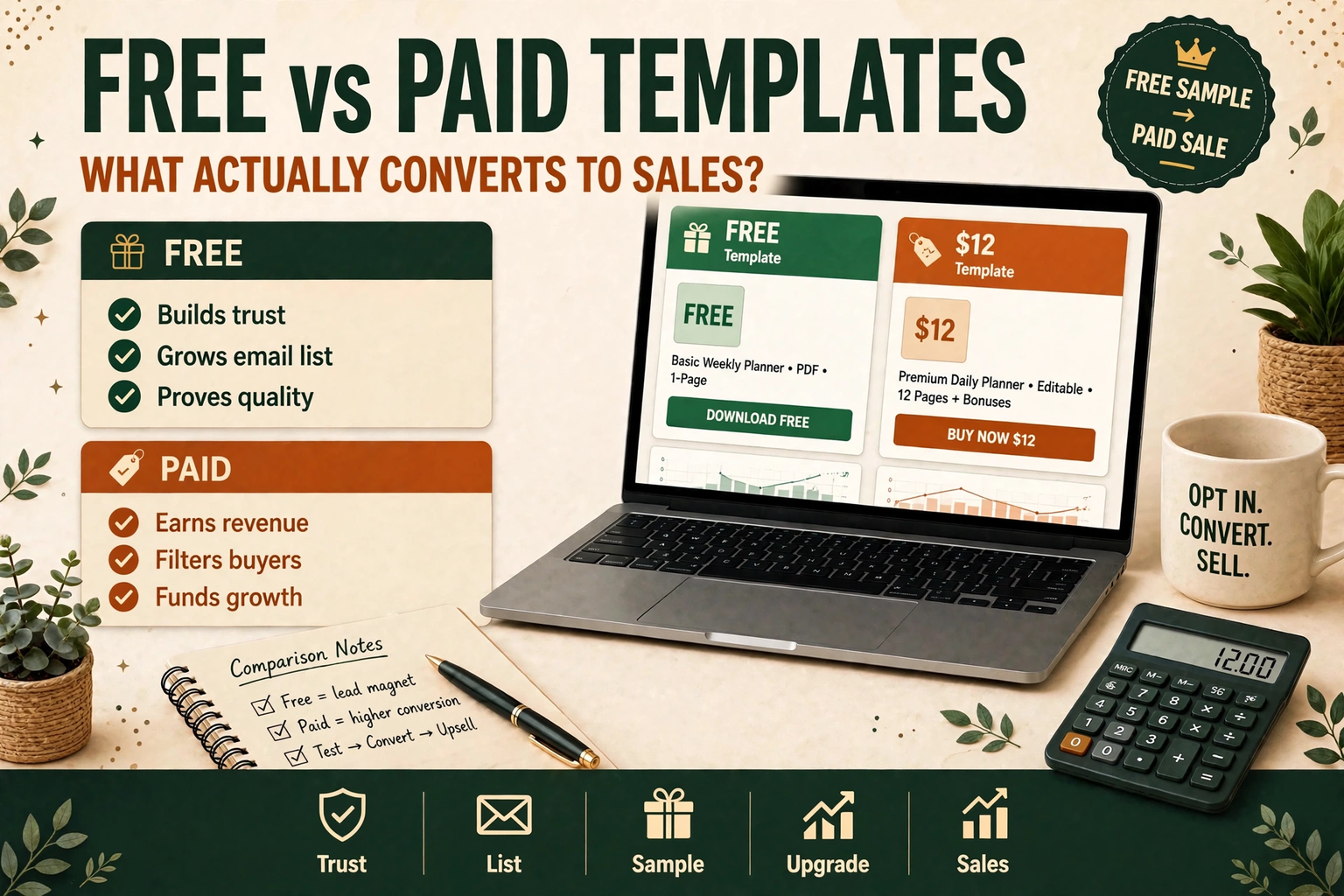
Should you give your templates away free or charge for them? Learn what actually converts free downloads into paid sales — the freebie trap, the paid-template advantage, and a simple funnel that turns free users into buyers.
Almost every beginner digital product seller faces the same question: should I give my templates away for free, or charge for them from day one? Free templates get downloads. Paid templates get money. What most sellers discover too late is that downloads and sales are two different things — and the choice is not really free or paid. It is free and paid, in the right order, for the right products.
This post explains what free templates actually do for a shop, what paid templates do better, and how to build a simple free-to-paid funnel that turns a free download into a paying customer. If you already have a product and it is not selling, the problem may not be your template at all — it may be that nobody has had a chance to try a free version of your work yet.
The freebie trap: downloads are not sales
A free template can get hundreds of downloads in a week. That feels like success. But a download is a weak signal. It costs the downloader nothing, so it tells you almost nothing about whether they would pay for anything. Many free-template shops collect email addresses and downloads for months and never see a sale, because the free product never pointed anywhere.
Free templates convert when they do three jobs at once:
- Prove your quality. The free version must be genuinely useful, not a watermarked teaser that frustrates people. A buyer who tries a clean, well-made free planner trusts that your paid planner is worth $12.
- Collect an email address. A download without an email is a one-time visit. A download with an email is the start of a relationship — you can follow up with the full version, a discount, or your next product.
- Lead to the paid version. The free template should solve one small problem and make the bigger problem obvious. A free one-week meal planner leads naturally to a paid 12-week planner bundle. A free single resume template leads to a paid pack of ten.
If your free template does none of these three things, it is not a marketing asset. It is a gift with no return address.
What paid templates do that free ones cannot
Paid templates earn money directly, but that is not their only job. A price does four things a free download cannot:
- It filters for serious buyers. Someone who pays $9 for a template has a real problem and real intent. Those buyers leave reviews, ask useful questions, and come back for the next product.
- It signals value. On Etsy and Gumroad, a $0 listing and a $15 listing are judged differently by buyers. A thoughtful price tells a buyer the work behind the template is real. A price of $1, by contrast, can make a good template look cheap.
- It funds the next product. Every paid sale pays for the time you spend making the next template, running the next promotion, or improving your listing photos.
- It creates data you can trust. Ten sales at $12 tells you far more about your market than a thousand free downloads. Sales are the only honest validation that a product is wanted.
The mistake is not charging. The mistake is charging for a template nobody has had a chance to trust yet — a new shop with no reviews, no free sample, and a $25 price tag is asking for trust it has not earned.
Free vs paid, side by side
| Free template | Paid template | |
|---|---|---|
| Main job | Build trust and grow your email list | Earn revenue and validate demand |
| What it costs the buyer | An email address (and a little trust) | Money — so the buyer expects more |
| Best size | Small and focused: 1–5 pages, one clear use | Complete: full pack, bonuses, instructions |
| Where it lives | Your site, Gumroad, or as a listing add-on | Etsy, Gumroad, or your own shop |
| Success metric | Downloads and email sign-ups | Conversion rate and revenue per visitor |
| Biggest risk | Lots of downloads, zero sales | No reviews and no traffic, so no sales |
Neither column wins on its own. A shop with only free templates has an audience and no income. A shop with only paid templates has products and no audience. The sellers who make consistent sales run both, with a clear path between them.
The funnel that actually converts
The simplest funnel that works for beginner sellers has four steps. You do not need paid ads or a big following to run it — you need one good free template and one good paid product that belong together.
Step 1: Make a free template worth downloading
Pick the smallest useful version of your paid product. If you sell a 50-page wedding planner bundle, the free version is a 3-page wedding day checklist. If you sell a social media template pack, the free version is five editable post templates. It must work on its own — nobody recommends a freebie that feels broken.
DigiDown's own free Budget Planner Pro works this way: it is a real, usable budget tool, and it shows the quality of the paid planner bundle it leads to.
Step 2: Put the paid offer inside the free product
This is the step most sellers skip. Your free template should contain the offer for the paid version — not as a pop-up or a pushy sales page, but inside the product itself. Add a final page or a short note: "This is page 1 of 12. The full bundle includes the yearly view, the debt tracker and 40 more templates — get it here." A buyer who just enjoyed your free work is at their most receptive in that moment.
Also add the same link in the delivery email. People download a freebie, forget where it came from, and never return. The email is your second chance to point them to the paid version.
Step 3: Follow up once, properly
One follow-up email, sent two or three days after the download, beats five emails sent in a week. Say what the free template can do, ask whether they tried it, and show them the paid version with one clear benefit — not a list of features, but the outcome: "Turn your free budget sheet into a full-year plan." If they do not buy, that is fine. They are still on your list for the next product.
Step 4: Let buyers upgrade themselves
Some buyers will never open your emails. They will find the paid version through your shop, your Etsy listing, or a Pinterest pin — but only if the paid listing is easy to find from the free one. Link the freebie page to the paid product, link the paid listing back to the free sample, and make the upgrade path obvious in both directions. Our digital product launch checklist covers this as part of a first-sale plan: launch the free version and the paid version together, not months apart.
What the numbers usually look like
Honest numbers keep expectations realistic. For a small shop, a typical free-to-paid funnel looks roughly like this:
- 100 people see the free template offer, and 20–40 download it.
- Of those, a handful — often 1–3 — buy the paid version in the first month.
- Over time, as the email list grows and the paid product gathers reviews, that conversion rate improves.
That sounds slow, and it is — until you compare it with the alternative. A paid-only listing with no free sample and no reviews often converts at well under 1% of visitors. The free template does not just add buyers; it adds the trust that makes the paid listing convert at all. If your paid product is getting views but no sales, read our guide to why your digital product isn't selling — a missing free sample is one of the most common causes.
When free is the wrong move
Free is not always right. Do not give away a template for free when:
- It is your only product. A shop with one free item and nothing to buy is a library, not a business. Launch the paid version at the same time.
- The free version is the whole product. If the free download does everything the paid one does, nobody has a reason to upgrade. The free version should be a sample, not a substitute.
- You cannot afford the support. Free users still ask questions. If a free template generates an hour of support emails a day, it is costing you more than it returns.
- You are giving away work you could sell. A template that took you two weeks to design deserves a price. Give away the small version; sell the full one.
When paid is the wrong move
Paid is not always right either. Do not charge for a template when:
- You have no reviews and no audience. A brand-new shop charging premium prices for an unproven template will struggle. A free sample earns the first reviews and the first email subscribers.
- The template is a lead magnet by design. A one-page checklist exists to bring people in. Charging $2 for it costs you more in lost sign-ups than it earns in sales.
- You are testing a new niche. Before building a full paid product for teachers, homeschool parents or freelancers, a free worksheet tests whether that audience even wants what you make. Our post on 15 digital product ideas for teachers is a good place to start that test.
Pricing the paid version so the free one pays off
The paid price should make the upgrade feel obvious, not painful. Three rules help:
- Price on the value, not the page count. A 5-page template that saves a buyer three hours is worth more than a 50-page pack of filler. Our guide on how to price digital products explains how to work this out with real examples.
- Keep the jump small. If the free version is genuinely useful, a paid version at $7–$15 feels like a natural next step. A $49 jump from a free sample needs far more trust — and far more proof — to convert.
- Show the difference clearly. The paid listing should state exactly what the free version does not include: more pages, more designs, commercial use, instructions, bonus files. If a buyer cannot see the difference in five seconds, they will not pay for it.
A simple plan for this week
If you have a template sitting on your computer right now, here is a one-week plan:
- Day 1–2: Cut a small, genuinely useful free version out of your best template.
- Day 3: Add the paid offer inside the free file and set up the delivery email.
- Day 4: List the paid version on your chosen platform — our comparison of Etsy vs Gumroad vs Stan Store helps you pick one.
- Day 5: Share the free template where your buyers already are — Pinterest, a relevant community, or your social profile.
- Day 6–7: Send the one follow-up email, then watch which step people stop at. That tells you what to fix next.
FAQ
Should my first product be free or paid?
Both, together. Launch one free template and one paid product that belong together. The free one brings people in; the paid one gives them somewhere to go.
How much of my product should I give away free?
Roughly 10–20% — enough to prove the quality and solve one small problem, not enough to replace the paid version. A 5-page sample of a 50-page pack is about right.
Do free templates hurt my paid sales?
Only when the free version is too complete. A good free sample increases paid sales because it removes the buyer's biggest fear: paying for something they have never tried.
Where should I offer the free template?
On your own site first, so you own the email list, and on Gumroad if you want a simple delivery link. Avoid putting your only free sample behind a marketplace listing where you cannot collect emails easily.
How long before a freebie starts converting?
Expect the first paid sales from a free template within a few weeks, not days. The freebie builds a list slowly; the sales follow the list. If nothing converts after a month, check whether the free version actually points to the paid one — most of the time, that link is missing.
The bottom line
Free templates build trust. Paid templates build income. Neither works well alone, and the sellers who treat them as two halves of one funnel — a useful free sample, a clear upgrade inside it, one honest follow-up — are the ones who turn downloads into sales. Start with the smallest free version of your best product, point it clearly at the paid version, and let the free downloads do the job paid ads cannot: prove your work before anyone spends a cent.